
CoreBiz SkillLab
Practise an interview answer in writing
Write a short answer in your own words before requesting feedback.
This guide uses CoreBiz SkillLab as its starting point. It combines the documented project capabilities with practical suggestions for planning and reviewing your own work. The suggestions below are guidance, not a claim that the application automates every step.
Start with a concrete task
Write a short answer in your own words before requesting feedback. Focus on one example and make your individual contribution clear.
Choose one question and one real example
Interview practice becomes more useful when an answer has a clear focus. Start with one likely question and select an experience that actually relates to it. Trying to include every achievement in one response can make the answer difficult to follow.
The example can come from study, a personal project or other relevant work, provided the context is honest. Explain what the situation required and what you personally did. A modest real contribution is a stronger foundation than a dramatic story you cannot support.
Write a first version in your own words before seeking feedback. This reveals the ideas you understand and the sentences that need help. If the first draft comes entirely from a suggestion, it can be harder to tell whether the final wording reflects your own experience.
Make the sequence easy to follow
Give enough context for the listener to understand the task, then explain your action and the outcome or lesson. The exact structure can vary, but the reader should not have to guess how one part of the story connects to the next.
Keep the individual contribution clear in a team example. Describe the work you handled and how it related to the wider project. Avoid switching between I and we in a way that makes the responsibility ambiguous.
Use details that support the answer rather than distract from it. A long description of the project background can consume the response while leaving little room for your actual decision. Keep returning to the question the interviewer asked.
Practice with a fictional draft
Imagine a learner answering a question about solving a problem. The first draft says the team faced difficulties but completed the project successfully. That response gives little evidence of what the learner noticed, decided or changed.
A better draft identifies a specific issue, explains the learner's action and describes the result without inventing a business metric. If the work was a classroom exercise, the response says so. The interviewer can then ask a useful follow-up about the actual experience.
This example illustrates an editing method, not a story to adopt as your own. Practice should help you explain genuine experience more clearly, rather than provide a collection of impressive fictional answers.
Use feedback to clarify meaning
SkillLab's workplace-English practice supports typed answers and AI suggestions for clearer sentences, examples and follow-up questions. Review the suggestions for meaning as well as fluency. A more formal sentence is not necessarily easier for you to understand or say naturally.
If a suggestion changes the facts, revise or reject it. The response should preserve your responsibility, the actual outcome and any important limitation. Clear English is useful only when it communicates the right account of the experience.
Ask about a specific unclear sentence when possible. Understanding why it is confusing can help with future answers, while repeatedly accepting complete rewrites may leave you dependent on wording you have not learned to construct yourself.
Review the answer beyond the typed draft
Read the response aloud in your own practice and notice where it becomes difficult to say. This is a suggested practice step, not a claim that the current typed workflow automatically assesses spoken delivery. Adjust unfamiliar phrasing so the answer remains natural and accurate.
Try a related follow-up question. You should be able to explain the decision, limitation or next step without returning to a memorized script. That flexibility is a useful check on whether the example is understood.
Keep the final answer concise enough to invite a conversation. Interview practice is not about producing the longest possible response. It is about making your experience understandable and giving the interviewer a truthful basis for further questions.
What the project provides
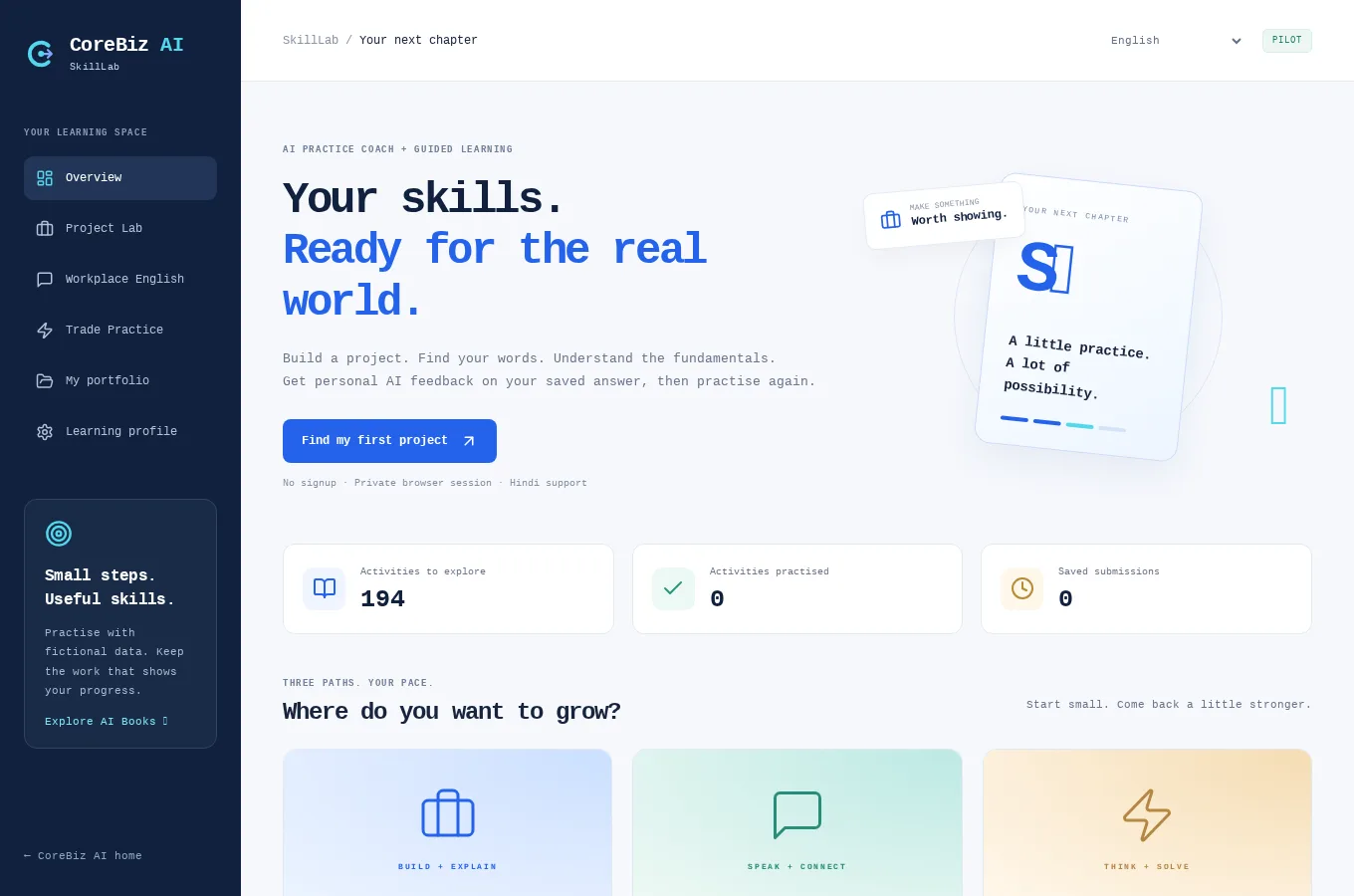
SkillLab is a practical learning pilot with three guided projects, ten workplace-English situations and 170 selectable DGT trade directory entries with guided theory worksheets, a custom branch option and ten original electrical quizzes. Save submissions, request optional AI feedback in English or Hindi, revise and keep a portfolio of final reflections. AI reviews the saved explanation; it does not open or verify project links. Typed practice is available; voice coaching is not included.
College students, first-job seekers, and ITI learners and polytechnic students practising course concepts.
Review the result before moving on
Use suggestions to improve clarity while preserving your meaning. Read the revised answer aloud in your own practice rather than memorizing unfamiliar phrasing.
Access and setup
No signup is required for the pilot. Progress belongs to a private browser session for 30 days; there is no account recovery or cross-device sync. Content administration requires the existing private-tools login. Trade exercises are not instructor-reviewed certification.
Common questions
How should I use a follow-up interview question in practice?
Answer it from the same real example rather than treating it as a new opportunity to invent a stronger story. A follow-up may ask why you chose an approach, what you learned or what you would change. Use it to check whether you understand the experience beyond the wording of the prepared response.
If you cannot explain a detail, review the actual project or choose a more suitable example instead of memorizing another generated sentence. Write a short answer first, then use feedback to improve clarity while preserving the facts. Keep your individual responsibility distinct from the team's work.
A question about what you would do differently can be answered honestly without implying that the original task failed completely. Explain the limitation and the reasoning behind a possible improvement. Read the revised answer aloud in your own practice if that helps, while remembering that the current typed workflow does not establish a comprehensive assessment of spoken delivery.
Avoid forcing every answer into a rigid script that makes a conversation sound unnatural. The useful preparation is a clear understanding of the example and a few well-supported points you can discuss flexibly. Record any terminology you need to clarify and practice explaining it simply.
A good follow-up session reveals where your understanding is strong and where you need to revisit the work, rather than merely increasing the number of polished paragraphs you have stored for possible questions during an interview.
Where can I find the current project details?
Read the CoreBiz SkillLab project page for its documented features, access notes and live application link.
Does this guide describe an automated workflow?
Only the capabilities explicitly described in the project section are product features. Planning and review suggestions may need to be performed manually.
Your next step
To explore a similar experience for your own audience, review our related service. Start the discussion with a concrete user task and the information needed to complete it.