
CoreBiz SkillLab
Use trade theory practice with clear limits
Select the relevant branch and choose a narrow theory topic.
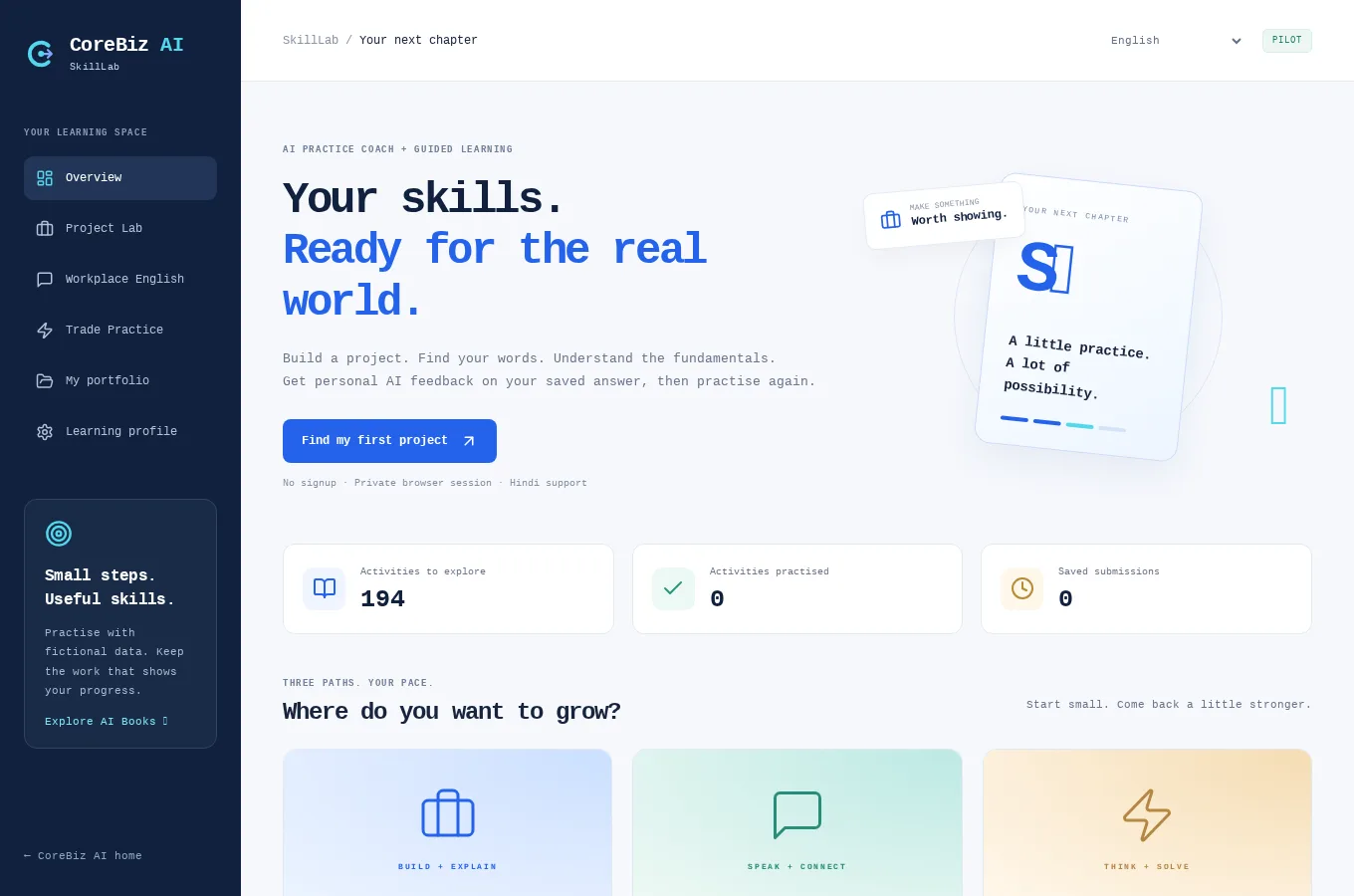
This guide uses CoreBiz SkillLab as its starting point. It combines the documented project capabilities with practical suggestions for planning and reviewing your own work. The suggestions below are guidance, not a claim that the application automates every step.
Start with a concrete task
Select the relevant branch and choose a narrow theory topic. Attempt the worksheet before reviewing optional AI feedback.
Match the practice to the topic you need
A trade or branch name is a starting point, not a complete learning objective. Identify the theory concept, terminology or process you want to review. A narrower topic makes it easier to choose relevant practice and to understand what the result tells you.
The SkillLab directory includes 170 DGT entries or a custom branch option, but that breadth does not mean every branch has the same fixed quiz coverage. The documented fixed quizzes are currently electrical only. Read the available activity rather than assuming identical content exists for every selection.
Use the practice as support for theory learning. It does not replace supervised practical instruction, assessment or the requirements of a qualification. Keep that boundary clear when deciding how to use an explanation outside the learning environment.
Attempt the worksheet before requesting feedback
Write your own answer and identify the source or reasoning behind it. This gives the review something concrete to examine. Reading a generated answer first can make it difficult to distinguish familiarity with the wording from understanding of the concept.
If a question is unclear, state the ambiguity rather than guessing which interpretation the tool expects. A useful follow-up can ask for a term or condition to be explained. Do not treat uncertainty as a reason to invent a confident technical response.
Keep the relevant course material available. Compare important explanations with the appropriate source and ask a qualified instructor about persistent uncertainty. The tool can support practice without becoming the sole authority for a trade topic.
Use a fictional theory-review example
Imagine a learner selects a branch and receives a worksheet about terminology. The learner answers one question correctly but cannot explain how the term relates to the process being studied. A follow-up should focus on that relationship rather than merely repeat the definition.
The learner then writes a short explanation using the course material and compares it with the feedback. If the explanation remains inconsistent, the next step is clarification from the relevant instructional source. This creates a review cycle grounded in evidence.
The example concerns theory study, not instructions to perform a physical task. It does not establish practical competence or authorize work on equipment. That distinction matters when a familiar-looking explanation could otherwise be mistaken for sufficient preparation for real-world action.
Evaluate optional AI feedback carefully
AI feedback can suggest clearer wording or identify a point to revisit, but it needs review. A fluent technical explanation can still be incomplete or wrong. Check the key statement against the source rather than accepting it because it uses familiar terminology.
Ask the feedback to address the specific answer you wrote. A general explanation of the whole topic may be interesting while leaving the actual mistake unresolved. Keep the review connected to the worksheet's learning objective.
Provider-dependent functionality may require the relevant configuration. Do not assume that every optional AI action is available in every deployment. Use the actual interface and documented setup as the basis for what the tool can currently do.
Keep a useful record of what remains uncertain
Record the concept, the difficulty and the next source of clarification. This is more useful than marking the whole branch as weak. A specific question gives an instructor or later practice session a clear starting point.
Review the same idea through a different theory question when appropriate. A new wording can reveal whether the learner understands the relationship or remembers only the first answer. The goal is a transferable explanation within the learning scope.
Treat progress as evidence to discuss, not a substitute for formal assessment. The practice lab can organize useful activity, while competence and qualification decisions belong to the appropriate instructional and assessment processes. Clear limits make the tool more useful, not less.
What the project provides
SkillLab is a practical learning pilot with three guided projects, ten workplace-English situations and 170 selectable DGT trade directory entries with guided theory worksheets, a custom branch option and ten original electrical quizzes. Save submissions, request optional AI feedback in English or Hindi, revise and keep a portfolio of final reflections. AI reviews the saved explanation; it does not open or verify project links. Typed practice is available; voice coaching is not included.
College students, first-job seekers, and ITI learners and polytechnic students practising course concepts.
Review the result before moving on
The directory contains 170 DGT entries, but fixed quizzes are currently electrical only. Theory practice does not replace supervised practical instruction or qualification assessment.
Access and setup
No signup is required for the pilot. Progress belongs to a private browser session for 30 days; there is no account recovery or cross-device sync. Content administration requires the existing private-tools login. Trade exercises are not instructor-reviewed certification.
Common questions
What if my selected branch does not have a fixed quiz?
Use the activities actually available for that branch and keep their limitations clear. The directory's breadth does not imply identical quiz coverage across every trade. The documented fixed quizzes are currently electrical only, while shared theory worksheets and optional AI feedback support other practice contexts.
Do not interpret the absence of a fixed quiz as evidence that the branch is unimportant or that a generated worksheet is equivalent to a formal assessment. Choose a narrow theory topic from your appropriate course material and use the available practice to explain or review that concept. Compare important statements with the relevant instructional source and ask a qualified instructor when uncertainty remains.
Keep practical work within the required supervised setting; a written explanation does not establish permission or competence to perform a physical task. Record the activity and what it helped clarify, without presenting it as a qualification result. If you need a particular assessment format, identify that requirement separately rather than assuming the current application provides it.
The useful approach is to match the tool to the learning task it can support, not to stretch its description until it appears to cover every need. Honest boundaries make your practice record more meaningful and help you decide when another resource or instructor is necessary.
Continue reviewing the actual project information as the product changes, because an available directory entry and a fully developed branch-specific assessment library remain distinct capabilities with different evidence behind them.
Where can I find the current project details?
Read the CoreBiz SkillLab project page for its documented features, access notes and live application link.
Does this guide describe an automated workflow?
Only the capabilities explicitly described in the project section are product features. Planning and review suggestions may need to be performed manually.
Your next step
To explore a similar experience for your own audience, review our related service. Start the discussion with a concrete user task and the information needed to complete it.