
AI Resume Checker
Interpret resume findings with evidence
Read the evidence behind a finding before rewriting a section.
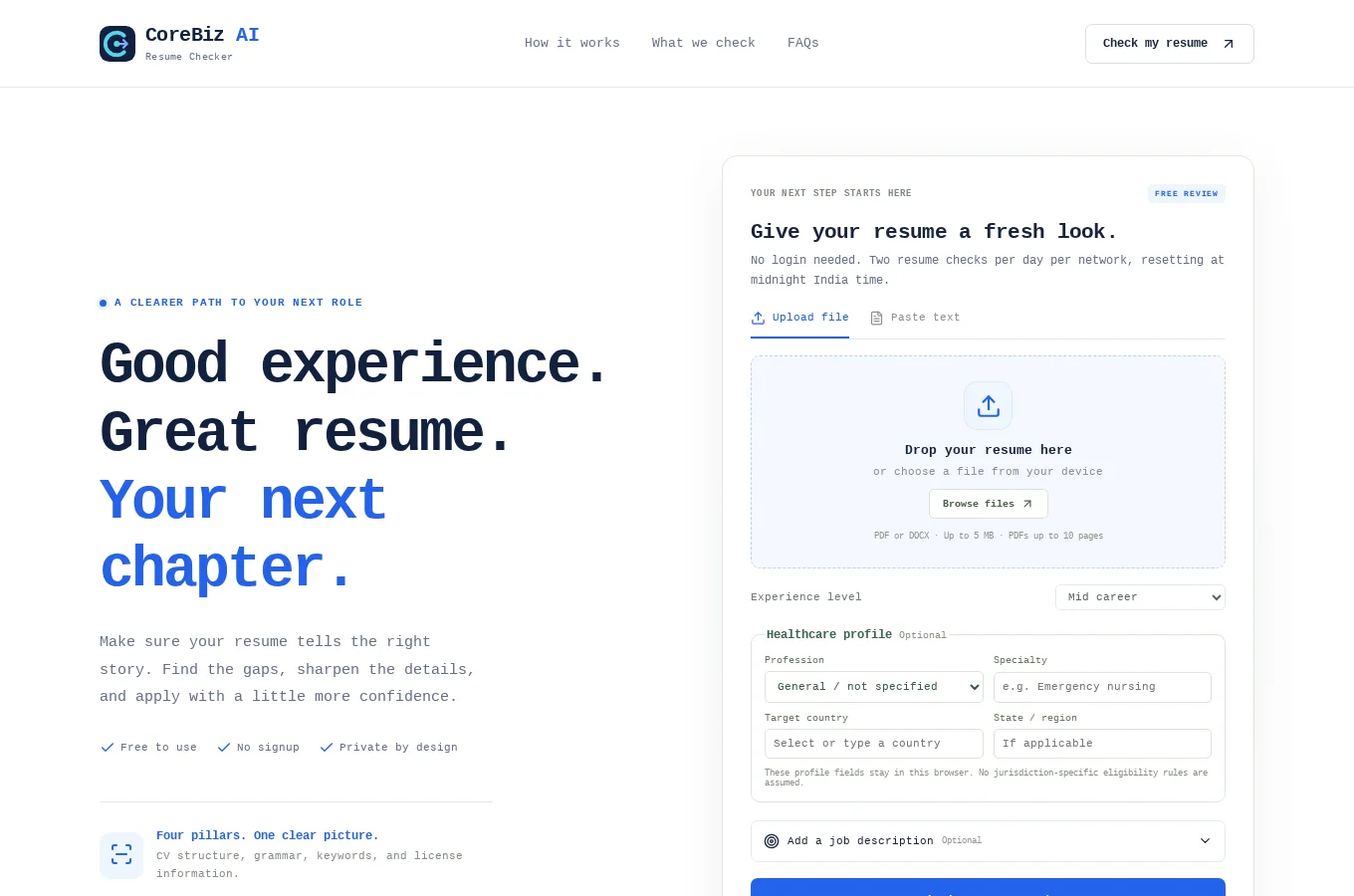
This guide uses AI Resume Checker as its starting point. It combines the documented project capabilities with practical suggestions for planning and reviewing your own work. The suggestions below are guidance, not a claim that the application automates every step.
Start with a concrete task
Read the evidence behind a finding before rewriting a section. Decide whether the suggestion reflects your target role and the experience you can support.
Read the evidence behind a finding
A resume finding is useful when you can connect it to a specific part of the document. Start with the cited wording or section rather than reacting only to the category label. This helps distinguish a genuine problem from a suggestion that may not fit your situation.
The project exposes 27 rule-check categories with findings and supporting evidence. That transparency supports review, but it does not mean every finding must be accepted without judgment. Rules can highlight patterns; the candidate still needs to decide how the wording represents their actual experience.
Do not interpret the report as a guarantee of acceptance by an employer or a particular applicant tracking system. Different hiring contexts can have different requirements. The useful goal is a clearer, more accurate document, not a promised universal score.
Separate factual corrections from editorial choices
A wrong date or missing qualification is a factual issue that should be corrected against your records. A suggestion about sentence length or emphasis is an editorial choice. Treating both as the same kind of instruction can make the revision process unnecessarily mechanical.
Resolve factual issues first because they affect the meaning of the document. Then consider whether the editorial suggestions help the target reader understand your contribution. A more polished sentence is not an improvement if it changes the responsibility you actually held.
Keep uncertainty visible while you investigate. Do not fill a gap with an invented number or title simply because a finding encourages specificity. Accurate detail is valuable; unsupported precision is not.
Review a fictional experience bullet
Imagine a candidate wrote helped with reports. A finding encourages a clearer description of the work. The candidate can identify the kind of report, the task performed and the context, such as organizing source data for a weekly team summary.
If the candidate does not have a measured efficiency result, they should not invent one. The revised bullet can still be stronger because it explains the contribution. Specificity does not always require a percentage or a claim about business impact.
This example illustrates how to use feedback as a question: what did I actually do, and how can I explain it? It is not a recommendation to adopt a prewritten achievement that belongs to someone else's experience.
Prioritize the changes that improve understanding
Start with issues that prevent a reviewer from following the document: unclear chronology, missing context or descriptions that conceal the candidate's role. Minor stylistic changes can wait until the central story is accurate and understandable.
Group related findings where one thoughtful edit can address the underlying issue. If several bullets are vague because they omit the task performed, review that pattern rather than applying isolated word substitutions. The goal is a consistent explanation of experience.
Avoid rewriting every section at once without preserving a comparison. A deliberate sequence makes it easier to see whether a change improved the document or merely made it different. Use the available version comparison or your own saved copies appropriately.
Keep the final decision with the candidate
Read the revised resume as if you were asked to explain each statement in an interview. You should be able to describe the work, context and limitations without relying on the review tool to defend the wording. That is a practical check on whether the revision remains yours.
If a suggestion does not fit, retain the original or write another version that does. The report is a source of structured feedback, not a replacement for the candidate's knowledge of their own history.
Finish by checking the complete document rather than only the edited lines. A local improvement can create repetition or an inconsistent emphasis elsewhere. The useful result is a coherent resume that presents real experience clearly, with the tool supporting the process rather than defining the person's identity.
What the project provides
CuraProfile is a resume review workspace with browser-side document parsing, transparent checks, evidence-based findings, and version comparison. Optional DeepSeek-assisted review is supported but is not enabled on this deployment until the provider is configured.
Job seekers and professionals reviewing their CV structure, wording, and evidence before applying.
Review the result before moving on
The 27 rule-check categories offer structured feedback. They are not a guarantee that an employer or a particular applicant tracking system will accept the document.
Access and setup
No login is required. Two resume checks per network (IP address) are available daily, resetting at midnight India time. PDF/DOCX parsing, rule checks, and version comparison are available. AI review requires separate provider configuration and explicit consent before resume text is sent to the provider.
Common questions
What if two suggestions seem to conflict?
Identify the purpose behind each suggestion and compare it with the target role and the actual document. One finding may encourage brevity while another points to missing context. The answer is not necessarily to choose one and ignore the other; a more specific sentence can sometimes provide the needed information with fewer vague words. Read the evidence behind both findings before editing.
If a rule appears to favor a change that would make the experience inaccurate, preserve accuracy and write an alternative. A resume is not a puzzle in which every indicator must be satisfied regardless of meaning. Consider the document as a whole, because a detail that appears unnecessary in one bullet may already be explained elsewhere.
Conversely, removing the only description of your contribution to shorten the text can make the section less useful. Keep a comparison copy so you can evaluate whether the revision improves the reader's understanding. If the conflict remains unclear, ask a trusted reviewer to explain what they understand from the relevant section without prompting them toward your preferred answer.
Their response can reveal whether the problem is actual ambiguity or simply a difference in style. Make the final decision based on truthful, relevant communication. The report provides structured feedback, but it does not know every aspect of your experience or the employer's context.
Document the choice if it helps future revisions, especially when you deliberately reject a suggestion for a clear factual or editorial reason rather than overlooking it accidentally.
Where can I find the current project details?
Read the AI Resume Checker project page for its documented features, access notes and live application link.
Does this guide describe an automated workflow?
Only the capabilities explicitly described in the project section are product features. Planning and review suggestions may need to be performed manually.
Your next step
To explore a similar experience for your own audience, review our related service. Start the discussion with a concrete user task and the information needed to complete it.