
AI Resume Checker
Write experience bullets you can defend
Start with the work you performed, then explain the result and context.
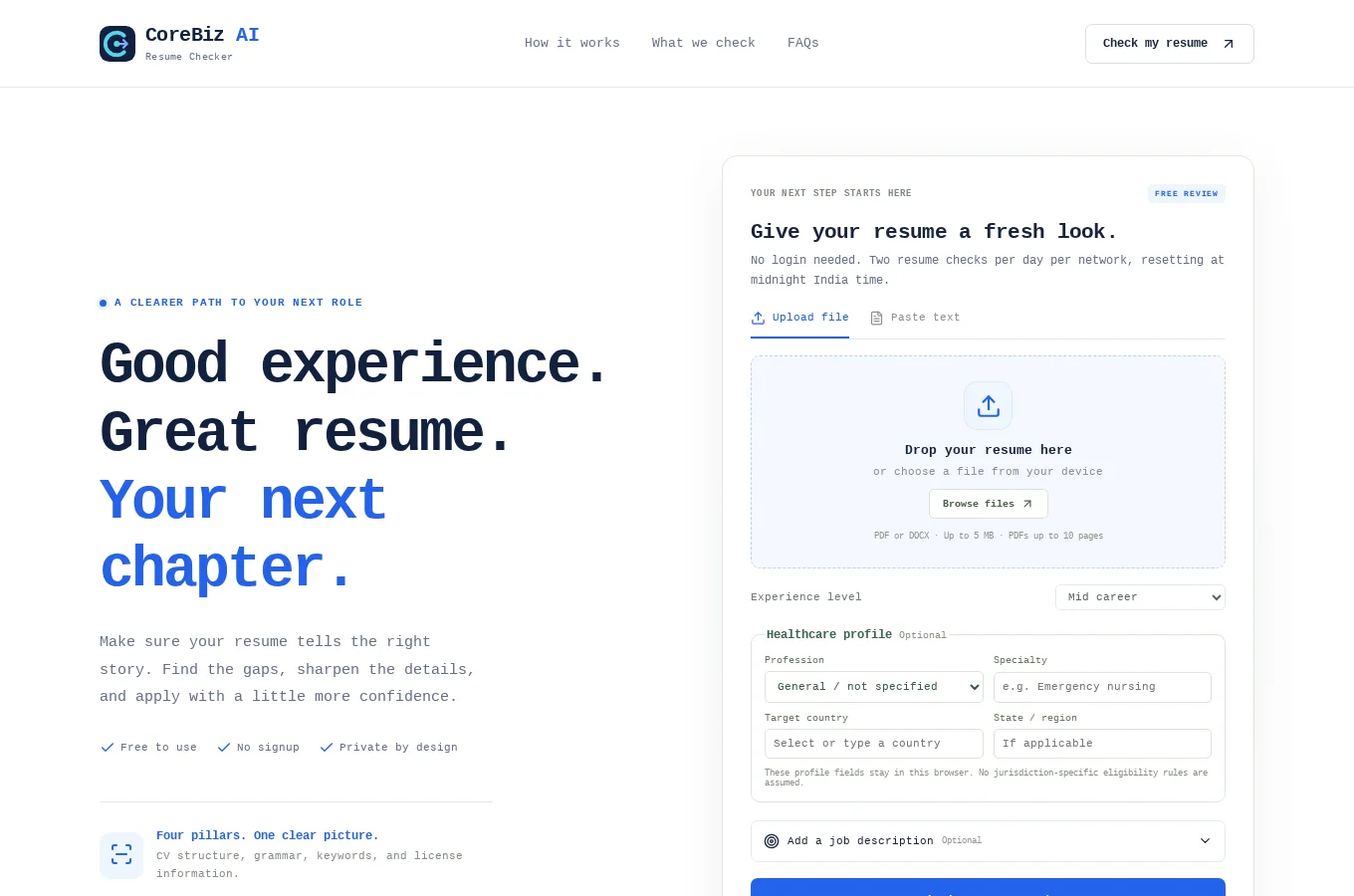
This guide uses AI Resume Checker as its starting point. It combines the documented project capabilities with practical suggestions for planning and reviewing your own work. The suggestions below are guidance, not a claim that the application automates every step.
Start with a concrete task
Start with the work you performed, then explain the result and context. Use a number only when you can support it from your own experience.
Start with the work you personally performed
An experience bullet should make your contribution understandable. Identify the task, the context and the part you owned. A team result can be relevant, but the reader should not have to guess whether you led the work, supported it or completed one component.
Use a verb that matches the responsibility. Organized, reviewed, implemented and assisted describe different actions. Choosing the strongest-sounding verb is not useful if it changes the meaning of the experience.
Keep the task concrete. Worked on a project gives little information, while describing the feature, document or process you handled gives the reader something to evaluate. Specificity can come from the work itself without requiring an impressive numerical result.
Explain the context that makes the action meaningful
A task becomes easier to understand when the reader knows why it was needed. You might have prepared information for a weekly review, built a prototype to test a workflow or revised a document for a particular audience. Include the context that helps explain the contribution.
Avoid adding every detail of the project. The bullet should remain readable and focused on the relevant work. Supporting context can appear elsewhere in the resume or in a portfolio example when the reader needs a fuller explanation.
Choose details that matter to the target role. A technical implementation decision may be useful for one application, while coordination or communication work may be more relevant to another. The underlying facts should remain the same even when the emphasis changes.
Use results only when you can support them
A measured outcome can strengthen a bullet, but it needs a defensible basis. Know what was measured, over what period and how your contribution relates to the result. Do not attach a team-wide business outcome to a small task without explaining that relationship.
If no measurement exists, describe the completed output or a verified practical effect. Delivering a documented prototype or organizing a usable reference file can still be meaningful. An honest account is better than a percentage invented because a template expects a number.
Distinguish a project goal from an achieved result. Designed to reduce confusion is not the same as demonstrated a reduction in confusion. The wording should tell the reader whether you are describing intent, completion or evidence of an outcome.
Work through a fictional revision
Consider the starting sentence helped build a website. A candidate can improve it by naming the component they implemented and the context in which it was reviewed. If the work was a college exercise, that context should remain clear.
A stronger factual version might explain that the candidate implemented a responsive contact page for a fictional service-site project and checked its layout at several screen widths. It describes work that can be shown without pretending the project generated real customer leads.
The example is not a sentence to copy into a resume unless it reflects your own work. Its purpose is to show how a vague claim can become a specific explanation through truthful detail rather than inflated language.
Check whether you can explain the bullet aloud
Imagine an interviewer asking how you completed the task, what was difficult and what you would change. You should be able to answer from your own experience. If the bullet depends on terminology you cannot explain, revise it until the wording matches your understanding.
Keep useful supporting material where you can review it appropriately. A project note, approved sample or personal reflection can help you remember the work. Do not retain or share confidential material merely to support a resume statement.
Finally, read the bullets together. They should reveal a coherent picture of your relevant experience rather than repeat the same action in different words. The goal is to make genuine work easy to understand and discuss, with every claim remaining something you can stand behind.
What the project provides
CuraProfile is a resume review workspace with browser-side document parsing, transparent checks, evidence-based findings, and version comparison. Optional DeepSeek-assisted review is supported but is not enabled on this deployment until the provider is configured.
Job seekers and professionals reviewing their CV structure, wording, and evidence before applying.
Review the result before moving on
Avoid replacing a modest true contribution with an impressive invented claim. A useful review makes your experience clearer without changing who did the work.
Access and setup
No login is required. Two resume checks per network (IP address) are available daily, resetting at midnight India time. PDF/DOCX parsing, rule checks, and version comparison are available. AI review requires separate provider configuration and explicit consent before resume text is sent to the provider.
Common questions
How should I describe a result when I only contributed one part of a team project?
Explain your part first, then place it within the team context without claiming sole responsibility for the overall outcome. Identify the component, task or decision you handled and what evidence you can show. If you mention a team result, make the relationship clear and avoid implying that your contribution alone caused it.
A reviewer should be able to distinguish what you personally completed from what the group achieved together. Use numbers only when they are accurate, relevant and supportable. Knowing that the team delivered a project does not automatically give you evidence for a percentage improvement or a customer impact claim. If the work was fictional or academic, retain that context.
You can still describe the constraints, review process and lessons learned without presenting the exercise as a commercial success. Prepare to answer follow-up questions about how your work interacted with other parts of the project. This is often more useful than trying to make the bullet sound as if you worked independently on everything.
If you are unsure how a result was measured, ask the appropriate project owner or omit the uncertain claim. Keep confidential information out of the resume and use approved material for any supporting portfolio example. A precise account of a limited contribution demonstrates understanding and honesty.
It gives the employer a clearer basis for discussing your abilities than a broad achievement statement that sounds impressive but becomes difficult to explain when the conversation turns to what you actually did.
Where can I find the current project details?
Read the AI Resume Checker project page for its documented features, access notes and live application link.
Does this guide describe an automated workflow?
Only the capabilities explicitly described in the project section are product features. Planning and review suggestions may need to be performed manually.
Your next step
To explore a similar experience for your own audience, review our related service. Start the discussion with a concrete user task and the information needed to complete it.